
National Carry AcademyCan You Recognize and Clear These 4 Types of Handgun Malfunctions
June 7, 2016
Everyone likes to go to the shooting range to fire their pistols, but all pieces of machinery have problems at times. Understanding the way to deal with the varying types of pistol malfunctions is important for your safety, as well as the safety of others, and will limit the amount of possible damage to your firearm.
Here we will explain the normal methods of clearing your handgun. There are many ways to clear your weapon when in a self-defense scenario, but for this particular piece, we will be explaining how to clear when at a shooting range.
First, we will explain the four most likely kinds of malfunction. Before using any gun, it is important to ensure that you understand how it operates.
 1. Hang Fire
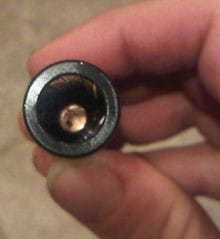
If the trigger has been squeezed but the gun doesn’t immediately fire, it could be an instance of Hang Fire. When there is a delay in the ignition of the propellant, this is referred to as hang fire. If you suspect that this is happening, the weapon should remain pointed down range for at least 30-60 seconds. This allows you to be certain that the propellant won’t be ignited. Once 60 seconds has passed, the gun should be cleared of the dud round and placed in water to safely ensure that it doesn’t ignite.
In modern pistols, it’s most likely the case that the round is a dud (and will never fire), but the precautions explained above should still be followed just in case.
 2. Squib Load
A very dangerous malfunction is what is known as a squib load. This is what happens when a bullet gets lodged inside the barrel because there was not enough force for it to exit. If you were to fire another round with a bullet still lodged in the barrel, the second round would strike the first, leading the barrel to bulge or break apart. Serious injury or death can be the result of this. The way to tell if it is squib load is that the shot is likely much quieter or muffled in sound than a regular shot being fired. It’s important to clear your weapon and check the barrel for any obstructions if something doesn’t sound right. *Note: NEVER look down the barrel of your firearm. Use an instrument that won’t damage the barrel, like a pistol, and place it inside to make certain it’s clear.
Squib Loads typically occur when a round has a primer, but little or no powder. This type of malfunction typically occurs with reloaded ammunition.
 3. Failure To Feed
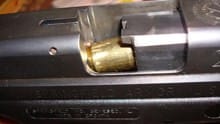
When a gun fails to feed the next round into the chamber, this is called a Failure to Feed (FTF). There are many reasons that this can happen. When FTF occurs, the slide will not be in full battery (all the way forward) because the cartridge has not moved enough to become chambered. To fix FTF, remove the magazine first, then the round. The round will usually drop down the magazine well when the slide is locked back.
 4. Stovepipe
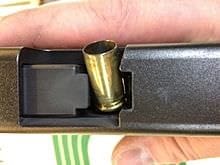
When the spent cartridge doesn’t eject properly, a Stovepipe occurs, which leaves the cartridge stuck in the ejection port at a vertical angle. “Limp wristing,” or not holding the gun properly, is usually the cause of this problem. When this happens, remove the magazine, and then lock the slide back to expel the cartridge.
Can You Recognize and Clear These 4 Types of Handgun Malfunctions
June 7, 2016
Everyone likes to go to the shooting range to fire their pistols, but all pieces of machinery have problems at times. Understanding the way to deal with the varying types of pistol malfunctions is important for your safety, as well as the safety of others, and will limit the amount of possible damage to your firearm.
Here we will explain the normal methods of clearing your handgun. There are many ways to clear your weapon when in a self-defense scenario, but for this particular piece, we will be explaining how to clear when at a shooting range.
First, we will explain the four most likely kinds of malfunction. Before using any gun, it is important to ensure that you understand how it operates.
1. Hang Fire
If the trigger has been squeezed but the gun doesn’t immediately fire, it could be an instance of Hang Fire. When there is a delay in the ignition of the propellant, this is referred to as hang fire. If you suspect that this is happening, the weapon should remain pointed down range for at least 30-60 seconds. This allows you to be certain that the propellant won’t be ignited. Once 60 seconds has passed, the gun should be cleared of the dud round and placed in water to safely ensure that it doesn’t ignite.
In modern pistols, it’s most likely the case that the round is a dud (and will never fire), but the precautions explained above should still be followed just in case.
2. Squib Load
A very dangerous malfunction is what is known as a squib load. This is what happens when a bullet gets lodged inside the barrel because there was not enough force for it to exit. If you were to fire another round with a bullet still lodged in the barrel, the second round would strike the first, leading the barrel to bulge or break apart. Serious injury or death can be the result of this. The way to tell if it is squib load is that the shot is likely much quieter or muffled in sound than a regular shot being fired. It’s important to clear your weapon and check the barrel for any obstructions if something doesn’t sound right. *Note: NEVER look down the barrel of your firearm. Use an instrument that won’t damage the barrel, like a pistol, and place it inside to make certain it’s clear.
Squib Loads typically occur when a round has a primer, but little or no powder. This type of malfunction typically occurs with reloaded ammunition.
3. Failure To Feed
When a gun fails to feed the next round into the chamber, this is called a Failure to Feed (FTF). There are many reasons that this can happen. When FTF occurs, the slide will not be in full battery (all the way forward) because the cartridge has not moved enough to become chambered. To fix FTF, remove the magazine first, then the round. The round will usually drop down the magazine well when the slide is locked back.
4. Stovepipe
When the spent cartridge doesn’t eject properly, a Stovepipe occurs, which leaves the cartridge stuck in the ejection port at a vertical angle. “Limp wristing,” or not holding the gun properly, is usually the cause of this problem. When this happens, remove the magazine, and then lock the slide back to expel the cartridge.